It feels as if a storm is menacingly brewing just beyond Vietnam. Hanoi prepares for its arrival, though hoping that it will bypass the region altogether. The streets are emptier and quieter. Temples have been told to close to preempt crowds. The ministry of health sends regular texts reminding people to wash hands, don face masks, and report to local authorities if feverish. It’s a social faux pas to go mask-less in public. Schools have been closed for a week now.
The virus’ potential for destruction does not, as with typhoons, depend on strong, swirling winds, but rather the movement patterns of its human hosts and the splattering trajectories of saliva. The severity of coronavirus has been exacerbated by humans in another way: as detailed in the NY Times, by a government that at first denied coronavirus’ existence. The Chinese government withheld information about it’s idiosyncratic form of pneumonia and potential severity. The secrecy allowed the virus to spread and infect unimpeded, by the time willful ignorance was no longer viable, extreme, draconian measures had to be put in place. And panic filled the vacuum of information.
There is no panic at the moment in Hanoi, a city always in uncomfortable proximity to China. Face masks and hand sanitizer are scarce, but still available for purchase. As of this writing, there have only been 13 reported cases in all of Vietnam–most likely an underestimation, but relatively low none the less. Officials have taken preventive and preparatory measures, and it feels as if the virus will arrive en masse at any moment. The military has been called in. Quarantine facilities are being outfitted and hospitals are being built on the fly. School closure has been extended. At this point, either there’s information, yet to be released to the public, that the spread of virus in VN will get much worse, or there is extreme caution and over-preparation as a preventive measure. This will have to break either way sooner or later, and we’re waiting to see which way.
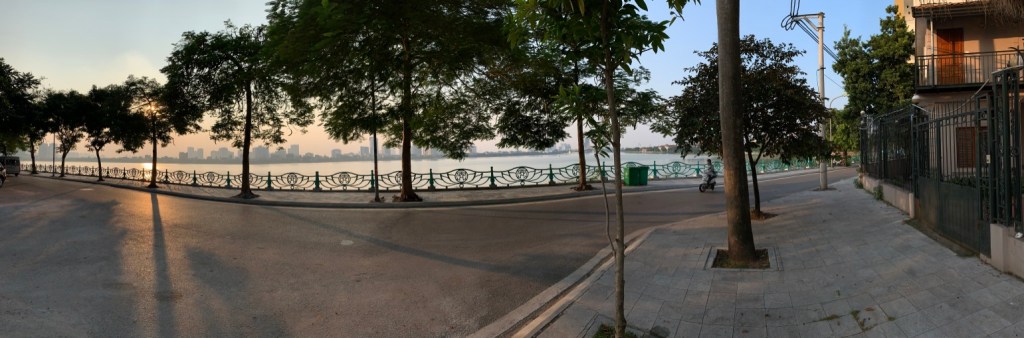
The sun setting over West Lake, in front of our new apt. A view from the kids’ new bus stop
We’ve been moving along West Lake (Hô Tây), the largest of Hanoi’s seven major lakes. Most of our daily commutes to school, cafes, stores, shops, etc. go around the lakeshore loop. The area we live in is also called West Lake, a peninsula that juts into the lake with three major roads and a network of alleyways off alleyways. (We have yet to figure our our new address because though the apartment is right off the lake’s loop, which is relatively new, we’re officially on an alley off of a major alleyway. So we have three addresses, with the official number marking the house address but also the alley off the alleyway: 96/94/12.) Once a land for cultivating house plants, flowers, and lotus flowers, the peninsula has become an expat area. The original diplomats and backpackers who lived here must’ve taken the name West Lake too literally. I’m sure there are other reasons this is an expat community (such as location, new housing stock customized for expats, etc.), but meh, I’d like to think of the expat community as being unironic.
Not too long ago, the lake experienced massive fish die-offs for a few consecutive summers. Fish of all sizes, from small to large, lifelessly surfaced to the lake top. The government had to deploy the military and line up trash truck after trash truck to take the corpses away. The haul weighed in the tons. Conspiracy theories emerged to explain the dead fish: a disgruntled contractor who didn’t get some bid or another dumping toxic chemicals to enact revenge upon the corrupt official in charge of the lake and contract. Then there are the Chinese who are always doing something harmful or another to the Vietnamese–continuing jabs, with the occasional devastating uppercut, to the face of their slighter, though more agile, southern neighbor for over a thousand years. Pollution, however, seldom seems to be an explanation. But the runoff from construction sites that one sees on a daily basis is a more convincing reason. God knows what else is being dumped or running into other parts of the lake.
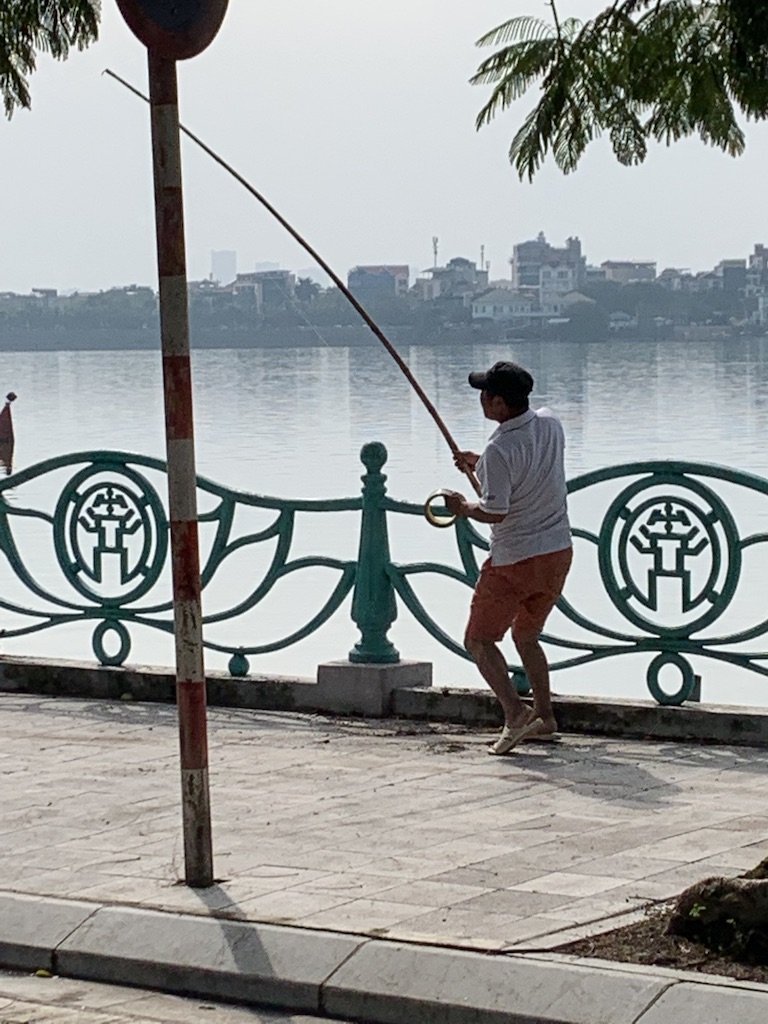
One of the most scenic and charming aspects of the lake is the dedicated anglers who are working the lake at all times of the day and with all kinds fishing styles. The men in front of our apartment net two or three fish a day that weigh from 4-7 lbs. I’ve recently learned that all of this fishing is technically illegal–that the police will repossess not only any fish caught, but all fishing gear and tackle. Initially, I thought that this was a reasonable government measure to prevent residents from being harmed by the toxic waste that killed the fish in recent years. Whatever the conspiracy theory, there have been unsuccessful attempts to increase the lake’s oxygen levels–not necessarily getting at the root of problem, though the fish have been restocked and seem to recover remarkably well. But I’ve come to learn that the government and police prohibit fishing not for people’s health, but because there is a company whose contracted, exclusive fishing rights need to be protected. This is a smaller-scale case of the government playing a direct hand in helping corporations, creating profit for the official(s) doling out the contracts–rather than working for the benefit of residents, be it for their health or daily sustenance.
Before the loop around the lake was built, some of the land right off the lake was unused swamp land. Rumor has it that the government had to build a road because residents were illegally dumping dirt under the cover of night, by the truck loads, to extend their property. The Vietnamese residents who resided on the unpaved lakefront have experienced skyrocketing real estate prices. Inland, there are swaths of land that are occupied by small shops and restaurants, businesses set up by people squatting on the land. Either there is no paperwork for the land or the land hasn’t been zoned for development–yet, these family and local businesses tenaciously operate between towering luxury apartment buildings and malls.
Postscript: Directly across the lake from us is the Lotte building, which houses an incredible Korean grocery store, a department store, restaurants, a kids play area, etc. A multi-storied air-conned building that addresses multiple wants and needs. It has become our destination on weekends with stifling heat and pollution. Reluctantly, I have to admit I’ve become that parent that I’ve never wanted to be: a parent who takes their kids to the mall to while away the weekend.
 southeastbysoutheast.travel.blog